
Intel vs. AMD Processors for Dedicated Servers - Which Is the Better Choice?
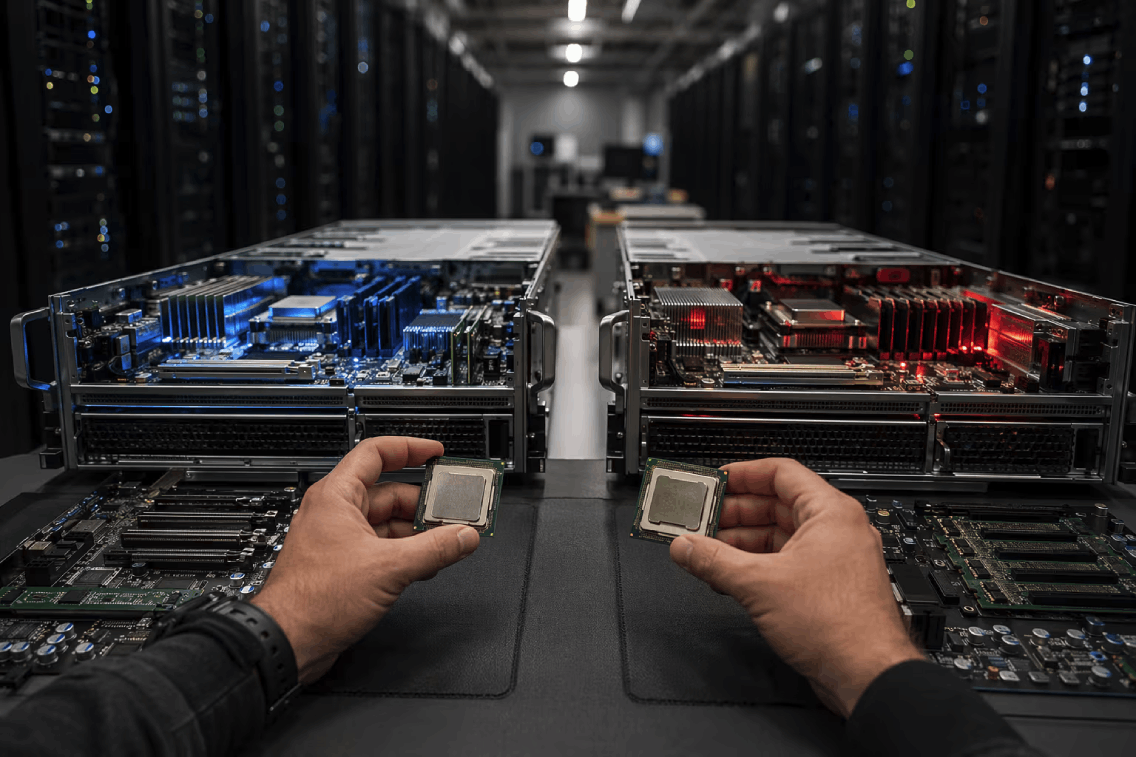
When you're choosing between Intel and AMD for a dedicated server, you're really deciding how your hardware will shape performance, stability, and long-term costs. Intel's Xeon line often wins on ecosystem maturity and predictable behavior, while AMD's EPYC chips push ahead in core density and efficiency. The "better" choice isn't obvious; it depends on what you run today and plan for tomorrow, and that's where things start to get interesting.
Intel vs AMD Dedicated Servers: Quick Answer and Key Differences
When you're choosing between Intel and AMD for a dedicated server, the key factor is how well each platform aligns with your specific workloads, performance targets, and budget.
Intel Xeon platforms are commonly used in environments that prioritize long-term stability, mature ecosystem support, and predictable behavior. They typically offer strong single-thread performance via high turbo frequencies, wide support for ECC memory, and extensive software and vendor certification, which can be important for proprietary enterprise applications and legacy workloads.
AMD EPYC platforms are generally oriented toward efficiency and scalability. They tend to provide higher core and thread counts per socket, increased memory bandwidth, and a larger number of PCIe lanes, which can be advantageous for virtualization, high-density hosting, and data-intensive applications on dedicated servers.
Both vendors use distinct socket and platform ecosystems (Intel's LGA-based server sockets vs. AMD's EPYC sockets), which can affect future upgrade options and hardware reuse. In practice, deployments that are highly sensitive to power usage and core density often lean toward AMD, while environments that depend on established certifications, conservative change management, and specific Intel-optimized software may lean toward Intel.
How Your Workloads Guide Intel vs AMD Server Choice
Now that you've seen the broad differences between Intel and AMD dedicated servers, the next step is to align those characteristics with your actual workloads.
For primarily single-threaded or latency-sensitive tasks, such as many game servers or certain transactional services, Intel's higher turbo frequencies can offer lower response times than simply adding more cores.
For highly parallel workloads, virtualization, CI/CD pipelines, container clusters, or video encoding, AMD EPYC processors, with their higher core and thread counts, often provide better aggregate throughput.
For memory- or I/O‑bound environments, EPYC's higher memory channel count per socket can improve performance for large numbers of virtual machines or containers.
In scenarios where power consumption or total cost of ownership is a key factor, AMD platforms often provide better energy efficiency, while Intel systems may be preferable when alignment with specific enterprise certifications or software vendor support lists is required.
Intel vs AMD Server CPU Families at a Glance (Xeon, EPYC, Core, Ryzen, Threadripper)
Choosing between Intel and AMD for a dedicated server starts with understanding their main CPU families and their intended use cases. On Intel's side, Xeon processors are the standard choice for traditional servers, offering features such as ECC memory support, larger cache sizes, and platform-level reliability options.
Common tiers include Xeon Silver (typically around 8–20 cores), Xeon Gold (often in the 16–32+ core range), and Xeon W (workstation‑class CPUs that can also be used in server roles, generally in the 12–38 core range, depending on generation).
On the AMD side, EPYC targets datacenter and enterprise deployments, emphasizing high core counts, strong multi-socket scalability, and extensive PCIe lane availability. Recent EPYC models, such as the 96‑core/192‑thread EPYC 9654, are designed for dense, multi-tenant, or highly parallel workloads.
For smaller-scale or more specialized servers, such as single-tenant hosting, development environments, or edge deployments, desktop or workstation lines are also used. These include Intel Core (commonly 4–24 cores in recent generations), AMD Ryzen (often 6–16 cores), and AMD Threadripper (workstation CPUs typically in the 24–64+ core range).
While these platforms may not offer the full set of server-focused features (such as multi-socket support or the same level of validated memory configurations), they can provide good performance-per-dollar and are suitable when extreme reliability and large memory capacities aren't the primary requirements.
Intel Xeon vs AMD EPYC for Enterprise Deployments
Intel Xeon and AMD EPYC both target enterprise server deployments but differ in design priorities, which can influence their suitability for specific workloads.
Xeon platforms are often selected when broad ISV certification, long-term platform stability, and predictable behavior under mixed or latency‑sensitive loads are important. Many databases, ERP, and virtualization stacks are validated first and most extensively on Xeon.
Common Xeon Silver and Gold processors typically offer 8–32 cores with base clocks around 2.1–2.8 GHz and turbo frequencies up to roughly 3.8 GHz, which can be beneficial for per-core performance in chatty or transaction‑oriented applications.
EPYC processors are generally more advantageous when workloads can leverage high core counts and memory bandwidth.
Current EPYC generations provide up to 96 cores and 192 threads per socket, along with up to 12 memory channels, which support higher aggregate throughput. This architecture often results in favorable performance per watt and performance per dollar for parallelizable workloads such as large-scale virtualization, microservices, big data processing, and certain HPC applications.
The choice between Xeon and EPYC typically depends on factors such as software certification requirements, workload characteristics (latency-sensitive vs. throughput-oriented), power and cooling constraints, and total cost of ownership over the system's lifecycle.
When Intel Core Makes Sense for Small Dedicated Servers
While Xeon and EPYC often dominate enterprise server discussions, Intel's Core series can be a practical choice for small dedicated servers where low latency and high per‑core performance matter more than maximum core count.
In these scenarios, workloads typically involve a limited number of latency‑sensitive applications rather than heavily parallel tasks that utilize many cores simultaneously.
Core i3 and i5 processors are generally suitable for lightweight web services, APIs, and gaming‑related workloads that benefit from higher clock speeds and strong single‑thread performance.
Core i7 and i9 models become more relevant when higher per‑core throughput is required, for example in game servers, matchmaking services, or control planes that rely on fast response times rather than large-scale parallel processing.
Using Intel Core CPUs can also simplify deployment compared to Xeon‑class platforms, which may involve additional features and configuration overhead that are unnecessary in smaller environments.
In addition, if existing software stacks, middleware, or commercial applications are already tested, optimized, or certified on Intel client platforms, this can further reduce risk and integration effort.
When AMD Ryzen and Threadripper Fit Prosumer and Lab Servers
AMD's Ryzen and Threadripper lines are most appropriate in prosumer and lab server scenarios where high multi-threaded performance per dollar is a priority, but a full enterprise server platform is unnecessary.
A Ryzen 9 7950X can support common lab workloads such as virtualization, CI/CD pipelines, and other mixed parallel tasks with good efficiency. It offers a large core count and strong single-thread performance at a relatively accessible cost.
Threadripper becomes relevant when additional core count, memory capacity, and PCIe lane availability are required. With 24–64 cores, it can sustain multiple heavy services concurrently, such as large builds, simulations, and video transcoding, without saturating CPU resources as quickly as mainstream desktop parts.
For homelab environments, current AMD platforms run hypervisors like Proxmox reliably, including on lower-power APUs for lighter workloads. Where reliability and expandability are priorities, pairing Threadripper with ECC RDIMMs and TRX50 motherboards provides access to higher memory capacities (commonly up to 256 GB or more, depending on the specific generation and board) and a larger number of PCIe lanes.
This combination is suitable for storage-focused builds and systems that need multiple NVMe drives, HBAs, or high-bandwidth network cards, without moving to a full dual-socket or enterprise server platform.
Performance, Cores, and Threads in Intel vs AMD Server CPUs
How do you decide whether Intel or AMD provides higher performance for your servers? The starting point is to align CPU characteristics with your specific workload.
Intel's Xeon processors typically offer higher peak turbo frequencies and strong single‑thread performance. This can benefit latency‑sensitive workloads such as certain OLTP databases, API gateways, and request brokers, where response time for individual queries matters more than total throughput. In these cases, a smaller number of faster cores can provide lower tail latencies.
AMD's EPYC processors, particularly the 9004 "Zen 4" and "Zen 4c" series, provide high core and thread counts per socket, currently up to 96 cores and 192 threads. These CPUs tend to perform well on highly parallel workloads that can effectively use many cores, such as virtualization hosts, container clusters, CI/CD farms, analytics jobs, and media encoding.
For these scenarios, aggregate throughput often improves as core counts increase, assuming the software scales well.
In practice, "faster" depends on whether your workload is constrained by single‑thread performance or by the total amount of parallel work the system can process. Intel often has an advantage in per‑core performance and turbo behavior, while AMD frequently offers higher performance per socket for well‑parallelized tasks, along with potential benefits in performance per watt and performance per dollar, depending on the generation and specific SKUs being compared.
Power, Heat, and Efficiency in Intel vs AMD Server Builds
Power, heat, and energy efficiency are often more important than peak performance when choosing between Intel- and AMD-based server builds for production environments. In recent EPYC generations, AMD typically offers higher performance per watt, which can allow a rack of AMD servers to deliver the same or greater throughput with lower overall power consumption and reduced cooling demands.
Thermal behavior still needs to be evaluated carefully. Many AMD server processors are specified to operate safely at relatively high temperatures (often up to the low‑ to mid‑90s °C, depending on the model and configuration), while Intel's thermal limits and typical operating ranges vary more across product lines and generations.
Similar TDP ratings don't guarantee similar operating temperatures in practice. For example, a 105 W Ryzen 9 3900X may run in the 70–75 °C range under sustained load with adequate cooling, whereas a 100 W Xeon Silver 4214R might operate closer to 65–70 °C under comparable conditions.
Differences in silicon design, boost behavior, power management, and platform configuration all contribute to these variations.
Total Cost of Owning Intel vs AMD Dedicated Servers and Choosing the Right Fit
While benchmarks and core counts draw attention, the total cost of owning an Intel or AMD dedicated server is more influenced by platform and operational expenses than by the CPU's purchase price.
Power consumption, cooling requirements, and software licensing typically have a greater long-term impact.
AMD EPYC often provides favorable performance per watt and per dollar for sustained, multi-core workloads, but very high core counts can increase costs for software licensed per core or per socket.
Both Intel Xeon and AMD EPYC platforms generally support ECC memory, hardware-assisted virtualization, and remote management features, so it's important to match specific platform capabilities to your monitoring, security, and management requirements.
When evaluating options, consider socket longevity, expected upgrade paths, and the ecosystem around each platform, including motherboard availability, memory compatibility, and vendor support.
It's also useful to compare complete server configurations, new or used enterprise systems, rather than focusing solely on CPU specifications, as chassis design, power supplies, and cooling solutions can significantly affect reliability and operating costs over the system's lifecycle.
Conclusion
When you're choosing between Intel and AMD for dedicated servers, let your workloads lead. If you need predictable stability, broad ecosystem support, and strong single‑thread performance, Intel Xeon usually fits best. If you're scaling virtual machines, CI/CD, or data-heavy apps, AMD EPYC often delivers more cores, bandwidth, and efficiency. For smaller or lab setups, Intel Core, Ryzen, or Threadripper can shine. Define your priorities, run test workloads, then pick the platform that aligns with real usage.

